Understanding Crypto Market Volatility
If you’ve been tracking **trending cryptocurrencies this week**, one pattern stands out immediately: price swings that can double or erase a position within hours. Crypto market volatility — the rate at which prices move — operates on a fundamentally different scale than traditional equities or bonds. Understanding what drives it is the first step toward making informed decisions.
Several forces amplify these swings. Low overall market liquidity, speculative trading behavior, regulatory news cycles, Federal Reserve interest rate decisions, and large “whale” wallets — held by investors controlling massive token supplies — can all move markets with minimal warning. Unlike the New York Stock Exchange, which uses circuit breakers and trading halts, most crypto exchanges run 24/7 with few structural guardrails.
**Bitcoin (BTC)** and **Ethereum (ETH)** — the two largest cryptocurrencies by market capitalization — tend to show lower percentage swings than smaller **altcoins** (any cryptocurrency other than Bitcoin). Low-volume altcoins can move 30–50% in a single day on minimal news, which makes the volatility spectrum a critical factor when building any portfolio.
- **Bitcoin dominance**: BTC often acts as a market bellwether; altcoins typically amplify its directional moves
- **Liquidity risk**: Thin order books mean a single large sell order can sharply crater a price
- **Sentiment cycles**: Crypto markets react quickly to social media trends and influencer commentary
- **Regulatory headlines**: A single SEC (Securities and Exchange Commission) enforcement action can trigger sector-wide selloffs
For a broader look at which assets are generating the most discussion right now, the trending cryptos category offers ongoing market context and analysis.
—
Managing Risk in Cryptocurrency Trading
Risk management in crypto isn’t optional — it’s fundamental to staying in the market long enough to learn from it. Without a structured approach, even well-reasoned positions can result in significant losses during volatile stretches. US-based retail investors should treat crypto as a high-risk asset class and size positions accordingly.
The most widely recommended framework is **position sizing**: never allocating more capital to a single crypto asset than you can afford to lose entirely. Many experienced traders cap any single crypto position at 1–5% of their total investable portfolio. **Stop-loss orders** — instructions to automatically sell an asset if it drops to a specified price — are a standard tool, though they’re imperfect in markets that gap down sharply overnight.
**Dollar-cost averaging (DCA)** involves investing a fixed dollar amount at regular intervals — say, $50 every week — regardless of price. DCA reduces the emotional pressure of timing the market and smooths out your average purchase price over time. It won’t eliminate risk, but it does reduce the danger of deploying a lump sum at a local price peak.
- **Set a hard budget**: Define your maximum crypto exposure before purchasing anything
- **Use DCA**: Automate regular purchases to reduce emotional timing decisions
- **Keep a cold wallet**: Hardware wallets protect assets from exchange hacks and platform failures
- **Diversify across asset tiers**: Avoid concentrating everything in micro-cap altcoins
- **Track your cost basis**: US tax law requires reporting crypto gains; portfolio tracking tools help maintain accurate records
—
Crypto Volatility: Risk or Opportunity?
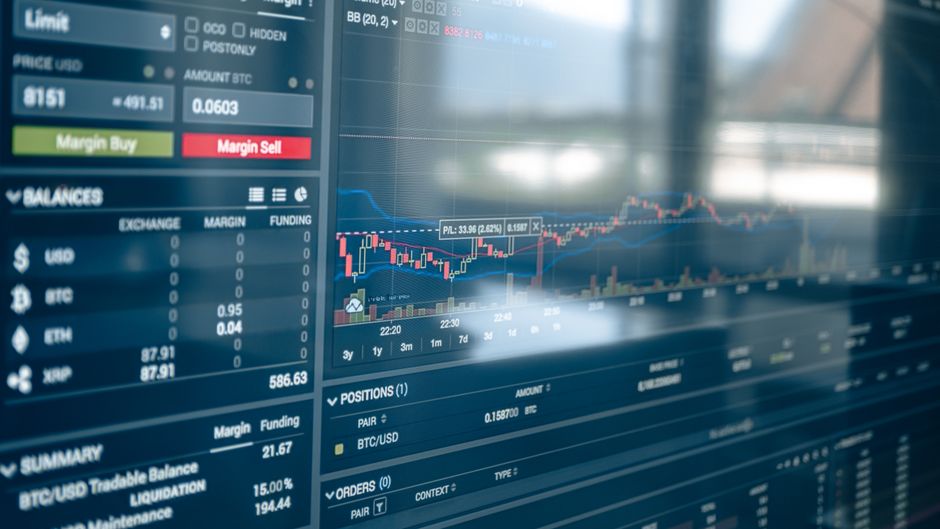
Volatility defines crypto markets — and it cuts both ways. For a long-term investor with high risk tolerance, volatility creates entry points where fundamentally strong assets trade at discounted prices due to panic selling. For a short-term trader with insufficient capital reserves, that same volatility can force premature liquidation at a loss.
The key analytical distinction is between **realized volatility** (how much an asset has already moved) and **implied volatility** (how much the options market expects it to move going forward). Both metrics are tracked in crypto through tools like the **Bitcoin Volatility Index**. When implied volatility spikes, options premiums rise — useful data even for investors who don’t actively trade options.
Historically, Bitcoin has experienced multiple drawdowns exceeding 80% from peak to trough. Long-term holders who maintained positions through those cycles have seen substantial appreciation in subsequent periods. That historical data point is not a guarantee of future results, but it does illustrate how time horizon dramatically reshapes the risk-reward equation.
| Investor Type | Volatility Perception | Typical Strategy |
|---|---|---|
| Long-term holder (HODLer) | Opportunity to accumulate | DCA, cold storage, multi-year horizon |
| Active swing trader | Exploitable price ranges | Technical analysis, stop-losses, smaller positions |
| Day trader | High-frequency profit potential | Tight risk controls, high experience required |
| Risk-averse retail investor | Significant threat | Minimal allocation, stablecoins for capital preservation |
—
Common Mistakes Made by Crypto Beginners
The crypto learning curve is steep, and the most costly beginner errors are predictable enough to prepare for. Identifying them before committing capital is one of the highest-value exercises any new investor can complete.
The single most damaging mistake is **investing without a plan**. Buying a coin because it appeared on a trending list — without understanding its use case, team, **tokenomics** (how token supply and distribution are structured), or competitive position — is speculation without a framework. Markets eventually punish undisciplined positioning.
A near-universal second mistake is **buying at the top of a hype cycle** and **panic-selling during the correction** that follows. **FOMO** (fear of missing out) drives buying spikes; **FUD** (fear, uncertainty, and doubt) drives the sell-off. Both are psychological phenomena that bad actors actively exploit through coordinated social media campaigns.
- **Ignoring fees**: Gas fees on Ethereum or exchange trading fees can significantly erode returns on small positions
- **Falling for rug pulls**: Fraudulent projects that collect investor funds and disappear are a persistent threat in **DeFi** (decentralized finance)
- **Losing private keys**: Losing a self-custody wallet’s seed phrase means permanent, unrecoverable loss of funds
- **Overtrading**: Frequent trading generates taxable events and increases cumulative fee exposure
- **Trusting anonymous tips**: Social media and Discord groups are common venues for coordinated pump-and-dump schemes
Staying informed about which projects are gaining legitimate traction — versus manufactured hype — is part of sound due diligence. Tracking trending cryptocurrencies with an analytical lens helps separate signal from noise.
—
Tips for Avoiding the Most Costly Crypto Mistakes
A structured approach significantly reduces the probability of the errors described above. The foundation is research — not surface-level price chart scrolling, but genuine due diligence on any asset before committing funds.
For any project under consideration, review its **whitepaper** (the technical document explaining the project’s purpose and architecture), verify the team’s credentials, examine on-chain activity (transaction volume, active wallets), and assess whether the tokenomics create sustainable incentives or primarily benefit early insiders. Blockchain explorers — such as Etherscan for Ethereum-based tokens — allow independent verification of on-chain claims.
Equally important is building **emotional discipline** into your process. Write down your investment thesis before entering a position — why you’re buying, at what price you’d reassess, and what would constitute a thesis failure. Reviewing that written rationale during volatile periods helps override the panic response that drives the most damaging decisions.
- **Use regulated exchanges**: US-regulated platforms carry compliance obligations that reduce — but do not eliminate — fraud risk
- **Enable two-factor authentication (2FA)**: This adds a critical security layer against account compromise
- **Start small**: A modest learning position is far less costly than a large, premature one
- **Cross-check news sources**: Verify developments through multiple credible outlets before acting on them
- **Understand tax obligations**: The IRS treats crypto as property; every trade, sale, or exchange may be a taxable event
—
Crypto Investing Dos and Don’ts
Distilling best practices into a clear framework helps US investors approach crypto with structure rather than impulse. The following guidance is educational and does not constitute personalized financial advice.
**Do** treat crypto as one component of a diversified portfolio rather than its entirety. Most US financial planning professionals suggest limiting speculative asset exposure to a proportion aligned with your overall risk tolerance and time horizon. **Do** keep accurate records of every transaction — the IRS requires reporting capital gains on crypto assets, and documentation is essential.
**Don’t** use leverage as a beginner. **Leveraged trading** amplifies both gains and losses — a 10x leveraged position can be liquidated by a 10% adverse price move. Don’t store significant holdings on an exchange long-term; exchanges have been hacked, declared bankruptcy, and frozen withdrawals under financial stress. Self-custody through a hardware wallet remains the standard recommendation for meaningful holdings.
| Action | Recommended Practice |
|---|---|
| Portfolio allocation | Keep crypto to a risk-appropriate percentage of total assets |
| Asset storage | Hardware wallet for long-term holdings; exchange only for active trading |
| Tax reporting | Track cost basis and all transactions; consult a tax professional |
| Research | Read whitepapers; verify team credentials; check on-chain data |
| Trading activity | Minimize unnecessary trades; each transaction may be taxable |
| Security | Use 2FA on all accounts; never share seed phrases |
—
Risk Disclaimer
**Cryptocurrency investments carry a high degree of risk.** Crypto assets are highly volatile and speculative in nature. Past performance of any asset is not indicative of future results. Nothing in this article constitutes personalized financial, investment, tax, or legal advice. US investors should consult a licensed financial advisor and a qualified tax professional before making any investment decisions. You may lose some or all of your invested capital.
—
Frequently Asked Questions (FAQ)
What is the most common mistake made by crypto beginners?
Entering the market without a defined investment plan is the most widespread error. Buying based on hype or a trending list — without researching the asset’s fundamentals, use case, or tokenomics — exposes investors to significant downside with no rational exit framework in place.
How can beginners avoid the most costly crypto investing mistakes?
Start with thorough research: read the project whitepaper, verify the team’s credentials, and check on-chain transaction data independently. Set a hard budget you can afford to lose entirely, use dollar-cost averaging to reduce timing risk, enable two-factor authentication on all accounts, and keep a written investment thesis to counteract emotional decision-making during volatile periods.
Is crypto volatility a risk or an opportunity?
It’s genuinely both — and the answer depends on your time horizon, risk tolerance, and capital reserves. Long-term investors who can afford to hold through drawdowns may find volatility creates favorable entry points. Short-term or undercapitalized investors face forced liquidation risk during those same periods. Assessing your personal financial situation honestly — ideally with a licensed advisor — is the only way to determine which framework applies to you.
How does the IRS treat cryptocurrency in the United States?
The IRS classifies cryptocurrency as property, not currency. That means every sale, trade, or exchange of crypto is a potentially taxable event subject to capital gains reporting. Accurate record-keeping of your cost basis and transaction history is essential for US tax compliance.
What is dollar-cost averaging and why do experienced investors recommend it?
Dollar-cost averaging (DCA) means investing a fixed dollar amount at regular intervals regardless of price. It removes the pressure of trying to time the market perfectly and smooths out your average purchase price over time. It does not eliminate risk, but it is a widely used strategy for reducing the impact of buying at temporary price peaks.
Charting & Exchange Resources
| Platform | Use Case | Key Feature | Fee Model | Action |
|---|---|---|---|---|
| TradingView | Charting & technical analysis | Indicators, multi-timeframe charts | Free / Pro tiers | View Platform |
| Coinbase | Exchange (beginner-friendly) | Simple USD on-ramp, educational tools | Varies by region | View Platform |
| Binance | Exchange (advanced pairs) | Wide altcoin coverage, spot markets | Varies by region | View Platform |
Affiliate Disclosure: This post contains affiliate links. We may earn a commission if you buy through our links, at no extra cost to you. Investment Risk Disclaimer: Cryptocurrency and digital asset markets are highly volatile. This content is for informational and educational purposes only and is not financial, investment, or trading advice. You may lose some or all of your capital. Do your own research and consult a licensed financial advisor before making investment decisions.
Leave a Reply