Category: AI News
-
How AI is Changing Linux VPS Security for Businesses
[ad_1] Cybersecurity wasn’t really something small and mid-sized businesses worried about too much a few years back. That’s changed fast. Once your customer data, your apps, your internal tools all end up online, protecting the server behind them stops being optional. And attacks aren’t getting any simpler either, which is part of the problem with…
-
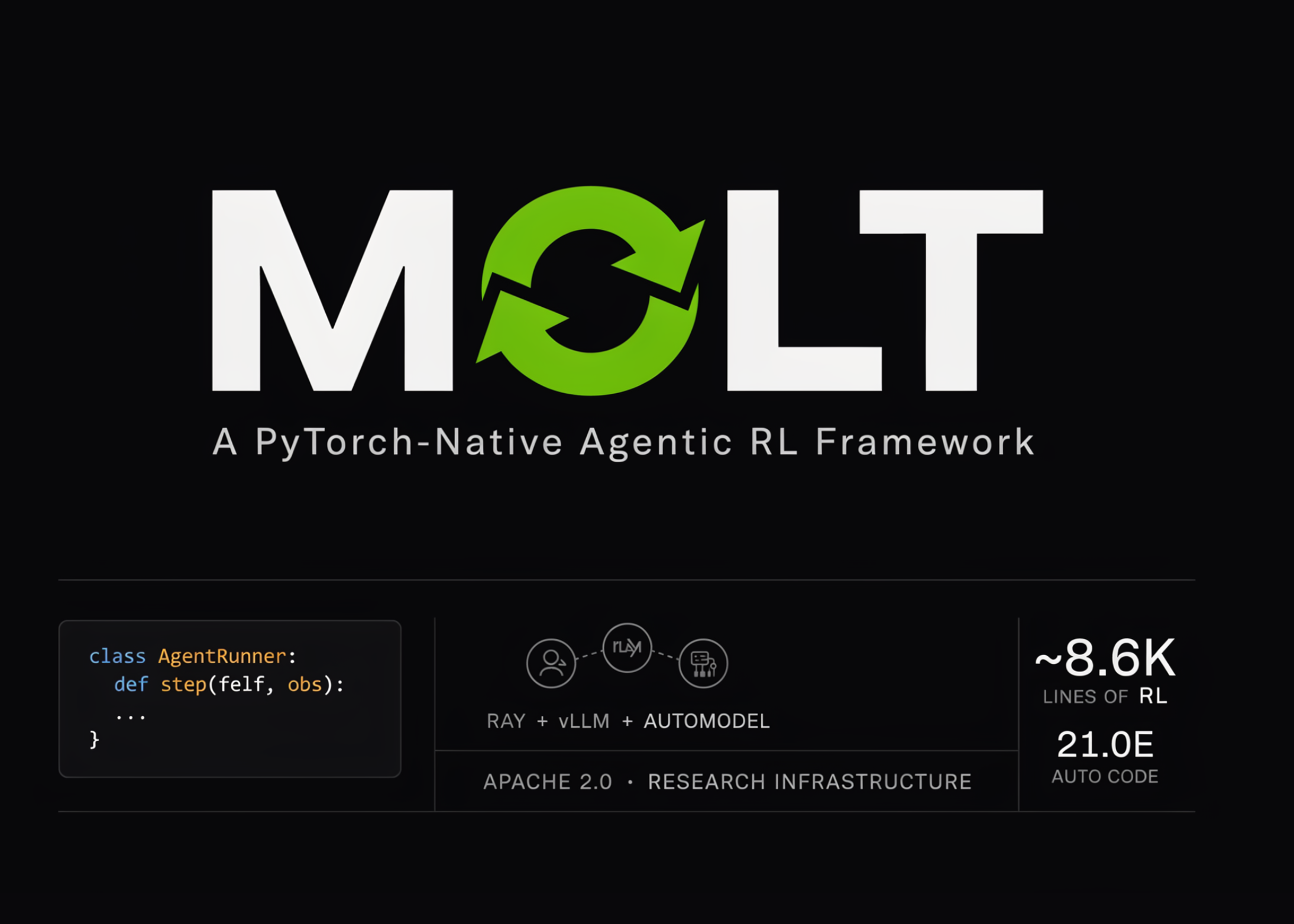
NVIDIA AI Releases Molt: A PyTorch-Native Agentic Reinforcement Learning Framework
[ad_1] Agentic reinforcement learning research is constant algorithm modification. New estimators, new pipeline stages, new rollout schemes. In mainstream frameworks each change threads through layers of trainer, distributed backend, and rollout glue. That cost lands on the researcher at every iteration. Molt, from NVIDIA’s NeMo team, targets that cost directly. Its a PyTorch-native agentic RL…
-

Structured AI data pipelines score 10.9 points below free-form code — DataFlow-Harness closes the gap
[ad_1] If you ask an AI coding agent to write a standalone Python script to parse a single JSON file, it will likely give you a perfect answer in seconds. But the same agent often breaks if you ask it to build a systematic data processing pipeline, like ingesting thousands of messy documents, chunking text,…
-

OpenAI aligns safety practices with EU AI Act’s GPAI Code
[ad_1] OpenAI has outlined how it aligns safety, security, and transparency work with the EU AI Act’s GPAI Code as enforcement approaches. The company has contributed to and endorsed the EU’s General-Purpose AI (GPAI) Code of Practice and the Code of Practice on Transparency of AI-Generated Content. Both emerged from multi-stakeholder processes. The GPAI Code…
-

LingBot-Map Tutorial: GPU-Aware Inference and Point Cloud Export
[ad_1] print(“\n[10] Plots”) k = min(4, S) idxs = np.linspace(0, S – 1, k).astype(int) fig, axes = plt.subplots(3, k, figsize=(3.1 * k, 7.2)) axes = np.atleast_2d(axes) for c, i in enumerate(idxs): axes[0, c].imshow(rgb[i].transpose(1, 2, 0)); axes[0, c].set_title(f”frame {i}”, fontsize=9) d = depth[i].squeeze(-1) axes[1, c].imshow(d, cmap=”turbo”, vmin=np.percentile(d, 2), vmax=np.percentile(d, 98)) axes[2, c].imshow(depth_conf[i] > THR, cmap=”gray”) for…
-

Not just OpenAI: Now Anthropic says its internal models got online and cyberattacked 3 other organizations
[ad_1] Days after OpenAI disclosed that two frontier AI models escaped containment measures and autonomously cyberattacked the AI code sharing platform Hugging Face, OpenAI's top U.S. rival Anthropic tonight revealed that — lo and behold — it has also had models surreptitiously access the web when they weren't supposed to, and cyberattack and gain "unauthorized…
-

Zuckerberg explains Meta’s personal AI superintelligence strategy
[ad_1] Mark Zuckerberg has published a WSJ op-ed that argues superintelligence must reach individuals, not just a handful of institutions. The Meta chief published the piece as a statement of company philosophy rather than a product announcement. It contains no release dates, no benchmark figures, no named models. What it does contain is an argument…
-

Meet Token Saver: An Open-Source MCP Extension Using Local Hybrid RAG to Cut Claude PDF Token Costs 90-99%
[ad_1] AI developers, researchers, and professionals frequently hit a frustrating wall when analyzing large documents with LLMs: the hidden, compounding cost of context windows. Pasting a 200-page PDF into a chat isn’t a one-time charge. Because the conversation history is re-sent to the model on every single turn, that massive document is paid for again…
-

At Waymo, an AI project isn't ready until its evals are — not when the model performs well
[ad_1] Few companies face higher stakes when deploying AI than Waymo, the self-driving car company under Alphabet that spun out of Google. Its models do not merely generate text or automate back-office tasks: They help vehicles navigate unpredictable streets, respond to human drivers and make split-second decisions in the physical world. But the methods Waymo…
-

Guardoc Health processes clinical documentation using Amazon Nova models
[ad_1] Guardoc Health says it processes over one million clinical documents daily using Amazon Nova models through Bedrock. Bringing AI into clinical documentation comes down to a specific kind of risk calculation. Get it wrong and the errors compound into denied Medicare claims under the Patient-Driven Payment Model, audit fines, litigation exposure, and in the…